
The answer to “Is mono and diglycerides halal or haram?” depends on where the ingredient comes from. Mono and diglycerides can be made from plant oils, animal fats, or a mixture of both. If they come from vegetable sources, they are generally considered halal. If they come from pork fat, they are haram. When the source is not clearly mentioned, the ingredient may be considered doubtful and requires further verification.
If you are asking whether mono diglycerides halal or whether monoglycerides pork is a concern, the safest approach is to check halal certification, contact the manufacturer, or choose products that clearly state the ingredient source.
Mono and diglycerides are among the most common food additives found in processed foods today. They are used in bread, cakes, cookies, chocolate, ice cream, margarine, peanut butter, and many packaged foods. Most people never notice them because they usually appear in small amounts on ingredient labels.
However, many consumers become concerned when they learn that mono and diglycerides can come from both plant and animal sources. This raises important questions about halal status, especially when the source is not listed on the package. In this guide, we will explain what mono and diglycerides are, how they are made, whether they can come from pork, and how Islamic scholars generally view them.
What Are Mono and Diglycerides?
Mono and diglycerides are food emulsifiers.
An emulsifier helps ingredients mix together that normally would not mix well.
For example:
- Oil and water
- Fat and milk
- Chocolate and cream
Food manufacturers use mono and diglycerides to improve texture, shelf life, and product stability.
They are often listed as:
- Mono and diglycerides
- Monoglycerides
- Diglycerides
- E471 (in some countries)
Why Are Mono and Diglycerides Used in Food?
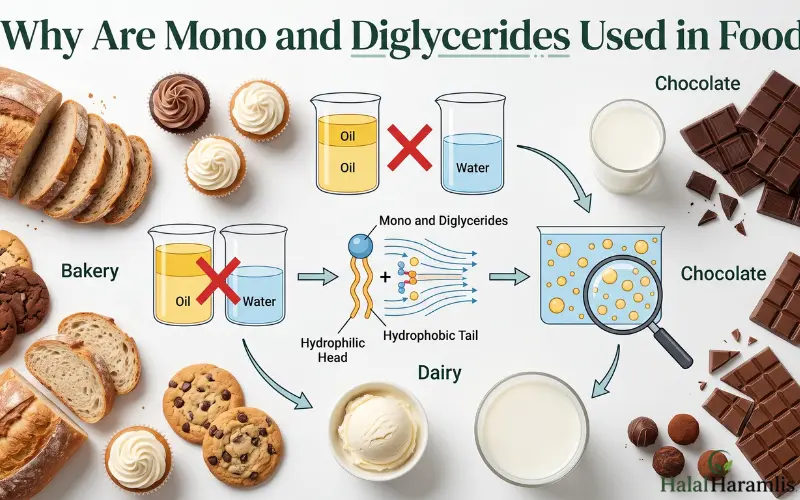
Food companies use them because they provide several benefits.
These benefits include:
- Improving texture
- Preventing ingredient separation
- Extending shelf life
- Making products softer
- Improving consistency
Without emulsifiers, many processed foods would not have the same appearance and texture consumers expect.
Foods That Commonly Contain Mono and Diglycerides
| Food Product | Often Contains Mono and Diglycerides |
| Bread | Yes |
| Cakes | Yes |
| Cookies | Yes |
| Ice Cream | Yes |
| Margarine | Yes |
| Chocolate | Sometimes |
| Peanut Butter | Sometimes |
| Processed Cheese | Often |
| Frozen Desserts | Often |
| Packaged Snacks | Often |
Because these additives are so common, understanding their halal status is important.
Is Mono and Diglycerides Halal or Haram?
This is the main question many consumers ask.
There is no universal answer.
The halal status depends on the source of the fat used during production.
Possible sources include:
- Vegetable oils
- Beef fat
- Chicken fat
- Fish oils
- Pork fat
If mono and diglycerides are produced from halal plant sources, they are generally halal.
If they are produced from pork fat, they are haram.
If the source is unknown, some scholars classify the ingredient as doubtful until further information becomes available.
Mono and Diglycerides Halal Status Overview
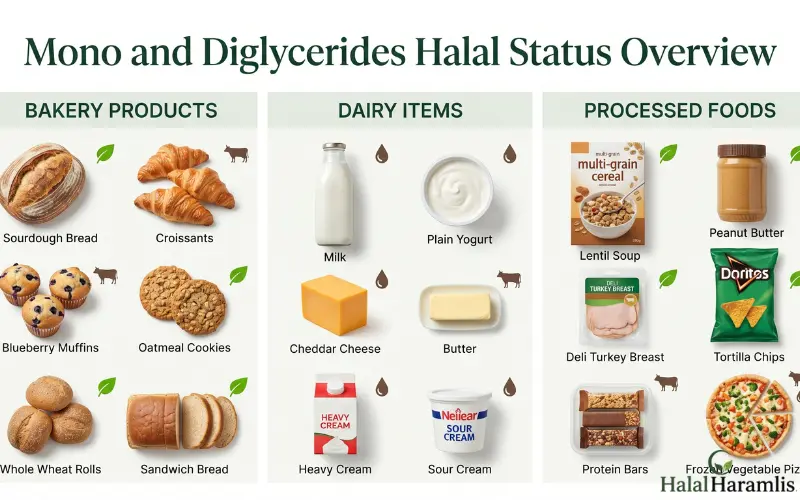
| Source | Halal Status |
| Vegetable Oil | Halal |
| Sunflower Oil | Halal |
| Palm Oil | Halal |
| Soybean Oil | Halal |
| Fish Oil | Generally Halal |
| Halal Beef Fat | Halal |
| Non-Halal Animal Fat | Doubtful |
| Pork Fat | Haram |
This table explains why identifying the source is important.
How Are Mono and Diglycerides Made?
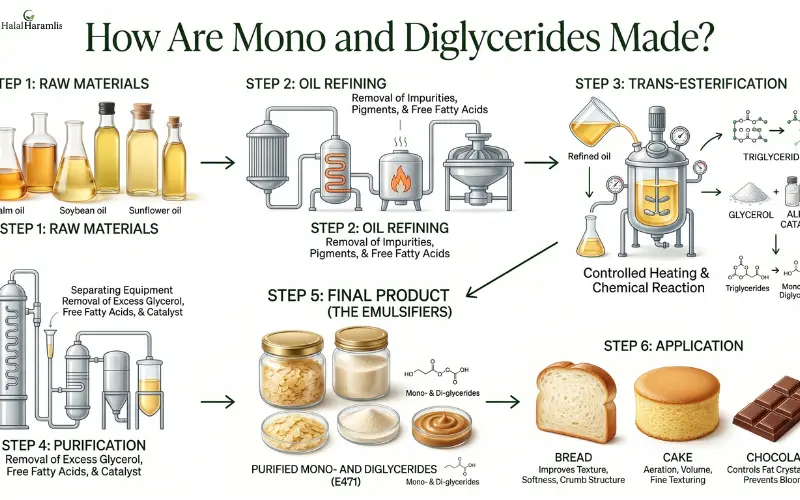
Manufacturers create mono and diglycerides by reacting glycerol with fats.
The process separates fatty acids and combines them with glycerol.
The final ingredient helps stabilize foods and improve texture.
The problem is that the original fat source is not always disclosed on food labels.
This is where halal concerns begin.
Can Mono and Diglycerides Come From Pork?
Many consumers search for:
Monoglycerides Pork
The answer is yes.
Mono and diglycerides can technically be made from pork fat.
However, they can also come from:
- Palm oil
- Soybean oil
- Sunflower oil
- Canola oil
- Beef fat
- Fish oils
The ingredient name alone does not reveal the source.
That is why consumers often seek halal certification or direct confirmation from manufacturers.
Are Mono Diglycerides Halal When Made From Plants?
Yes.
When mono and diglycerides come from plant oils, most scholars consider them halal.
Common halal sources include:
- Palm oil
- Soybean oil
- Sunflower oil
- Coconut oil
- Canola oil
These sources are widely used in modern food manufacturing.
For this reason, many mono and diglycerides used today are actually plant-based.
Plant-Based Sources of Mono and Diglycerides
| Plant Source | Halal Status |
| Palm Oil | Halal |
| Soybean Oil | Halal |
| Coconut Oil | Halal |
| Sunflower Oil | Halal |
| Canola Oil | Halal |
| Corn Oil | Halal |
Plant-derived versions are generally the safest option for halal-conscious consumers.
Why Are Mono and Diglycerides Considered Doubtful?
The biggest issue is labeling.
Food labels usually state:
“Mono and Diglycerides”
But they rarely specify:
- Plant source
- Animal source
- Pork source
- Beef source
Without this information, consumers cannot easily determine the halal status.
Some scholars recommend avoiding doubtful ingredients when a clear halal alternative is available.
Others allow consumption when there is strong evidence that plant sources are commonly used.
Scholar Opinions on Mono and Diglycerides
Islamic scholars generally divide the issue into three categories.
Clearly Plant-Based
Halal.
Clearly Pork-Based
Haram.
Unknown Source
Requires further investigation.
Many halal certification organizations evaluate mono and diglycerides before approving products.
This helps remove uncertainty for consumers.
Ingredient Source Comparison
| Source Type | Ruling |
| Plant-Based | Halal |
| Fish-Based | Halal |
| Halal Animal Source | Halal |
| Unknown Animal Source | Doubtful |
| Pork Source | Haram |
This simple comparison explains why ingredient sourcing matters so much.
Alcohol, Gelatin, and Enzyme Concerns
Many people confuse mono and diglycerides with other ingredients that may raise halal concerns.
While mono and diglycerides themselves are emulsifiers, they are often discussed alongside ingredients such as:
- Gelatin
- Enzymes
- Alcohol-based flavorings
- Animal-derived additives
Understanding the difference helps consumers make better decisions.
Do Mono and Diglycerides Contain Gelatin?
A common question is whether mono and diglycerides contain gelatin.
The answer is usually no.
Mono and diglycerides are different ingredients and are not gelatin.
However, a food product may contain both:
- Mono and diglycerides
- Gelatin
This is why reading the full ingredient list is important.
Gelatin vs Mono and Diglycerides
| Ingredient | Purpose |
| Gelatin | Thickener and gelling agent |
| Mono and Diglycerides | Emulsifier |
| Pectin | Plant-based thickener |
| Lecithin | Emulsifier |
| Carrageenan | Stabilizer |
Although they serve similar functions in some foods, they are different ingredients.
Do Mono and Diglycerides Contain Alcohol?
Generally, mono and diglycerides themselves do not contain alcohol.
However, products that contain mono and diglycerides may also include:
- Flavor extracts
- Artificial flavors
- Alcohol-based flavor carriers
For this reason, the overall product should be reviewed rather than focusing on only one ingredient.
What Is E471?
In many countries, mono and diglycerides are listed as:
E471
E471 is one of the most common food additives used worldwide.
It is found in:
- Bread
- Ice cream
- Chocolate
- Margarine
- Processed foods
The halal concern regarding E471 is exactly the same as mono and diglycerides because they are essentially the same ingredient.
Is E471 Halal or Haram?
The answer depends on the source.
If E471 Comes From Plants
Halal.
If E471 Comes From Pork
Haram.
If E471 Comes From Unknown Animal Sources
Further verification may be needed.
This is why some halal certification organizations carefully inspect E471 before approving products.
Why Food Labels Do Not Specify the Source
Many consumers wonder why companies do not simply state the source.
There are several reasons:
- Label space limitations
- Manufacturing flexibility
- Supplier changes
- Regulatory requirements
Because regulations in many countries do not require disclosure of the source, consumers may need additional verification.
Country-Wise Halal Status of Mono and Diglycerides
Different countries have different food manufacturing practices.
| Country | Typical Situation |
| USA | Source Often Not Listed |
| UK | Source Often Not Listed |
| Canada | Verification Recommended |
| Australia | Check Certification |
| Malaysia | Easier To Verify |
| UAE | Better Halal Labeling |
| Saudi Arabia | Better Halal Controls |
This is one reason halal-certified products are often preferred.
How Halal Certification Organizations Handle Mono and Diglycerides
Halal certifiers do not automatically reject products containing mono and diglycerides.
Instead, they investigate:
- Ingredient source
- Manufacturing process
- Supplier records
- Production methods
Only after verification can halal certification be granted.
Why Halal Certification Matters
Halal certification helps remove uncertainty.
Benefits include:
- Ingredient verification
- Manufacturing inspections
- Cross-contamination controls
- Supplier audits
- Consumer confidence
When a product carries a trusted halal logo, consumers do not need to guess where mono and diglycerides came from.
Foods Most Likely to Contain Mono and Diglycerides
Many everyday foods use these additives.
Bakery Products
- Bread
- Buns
- Cakes
- Muffins
Frozen Foods
- Frozen desserts
- Frozen pastries
Dairy Products
- Ice cream
- Whipped toppings
Snack Foods
- Crackers
- Cookies
- Packaged snacks
Consumers who frequently eat processed foods often consume mono and diglycerides regularly.
How to Identify Halal-Friendly Products
When shopping, consider the following steps.
Step 1: Check the Ingredient List
Look for:
- Mono and diglycerides
- E471
- Emulsifiers
Step 2: Check for Halal Certification
A halal logo provides additional confidence.
Step 3: Contact the Manufacturer
Many companies will provide ingredient source information.
Step 4: Research the Brand
Some brands publicly state that their mono and diglycerides are plant-based.
Consumer Guide: What Should You Do?
Consumers generally fall into three categories.
Strict Approach
Avoid products with unknown mono and diglycerides sources.
Moderate Approach
Consume products when plant-based sourcing is likely.
Certification-Based Approach
Choose only halal-certified products.
Each approach is based on personal comfort and scholarly guidance.
Common Misconceptions About Mono and Diglycerides
Many myths exist online.
Myth 1: All Mono and Diglycerides Are Haram
False.
Many come from plant oils.
Myth 2: All Mono and Diglycerides Come From Pork
False.
Pork is only one possible source.
Myth 3: E471 Is Always Haram
False.
E471 may be halal or haram depending on its source.
Myth 4: Halal Certification Is Unnecessary
False.
Certification helps verify ingredient origins.
Foods That Often Use Plant-Based Mono and Diglycerides
| Product Category | Plant-Based Use Common? |
| Bread | Yes |
| Cakes | Yes |
| Ice Cream | Yes |
| Chocolate | Yes |
| Margarine | Yes |
| Snack Foods | Yes |
Plant-based sources are common in modern food production because they are often cheaper and easier to obtain.
Are Mono and Diglycerides Safe to Eat?
Food safety authorities around the world generally approve mono and diglycerides for food use.
They are widely used in commercial food production.
The main concern for halal-conscious consumers is not safety but source verification.
Scholar Opinions on Mono and Diglycerides
Most scholars agree on the following:
| Source | Islamic Ruling |
| Plant Source | Halal |
| Fish Source | Halal |
| Halal Animal Source | Halal |
| Unknown Source | Doubtful |
| Pork Source | Haram |
The disagreement usually concerns products where the source cannot be identified.
Best Halal Alternatives
If you wish to avoid uncertainty, look for products that use:
- Sunflower lecithin
- Soy lecithin
- Pectin
- Plant-based emulsifiers
- Halal-certified additives
These ingredients often provide similar functions while reducing uncertainty.
Related Halal Guides
FAQs
Is mono and diglycerides halal or haram?
It depends on the source. Plant-based versions are generally halal, while pork-derived versions are haram.
What are mono and diglycerides?
They are emulsifiers used to improve texture and shelf life in processed foods.
Are mono diglycerides halal?
Many are halal because they come from vegetable oils, but verification is recommended.
Can monoglycerides come from pork?
Yes, pork fat can be used as a source.
Is E471 halal?
E471 may be halal or haram depending on the source used.
Do mono and diglycerides contain gelatin?
No, they are different ingredients.
Do mono and diglycerides contain alcohol?
Typically no, but other ingredients in the product should also be checked.
Are mono and diglycerides vegan?
Some are vegan, while others may come from animal fats.
Why is the source not listed?
Food labeling laws in many countries do not require source disclosure.
How can I verify the source?
Contact the manufacturer or choose halal-certified products.
Are mono and diglycerides common?
Yes, they are among the most widely used food additives in the world.
What is the safest option?
Choose products with trusted halal certification and transparent ingredient sourcing.
Conclusion
The answer to “Is mono and diglycerides halal or haram?” depends entirely on where the ingredient originates. Mono and diglycerides can be produced from vegetable oils, fish oils, halal animal fats, or pork fat. Because food labels rarely identify the source, uncertainty can sometimes exist.
For consumers seeking the clearest answer, halal certification remains the most reliable solution. Products certified by reputable halal organizations have typically undergone ingredient and manufacturing reviews, reducing doubts about mono and diglycerides.
In general, plant-based mono and diglycerides are considered halal by most scholars, while pork-derived versions are clearly haram. When the source cannot be determined, consumers may choose to investigate further or select halal-certified alternatives for greater peace of mind.